
Who Should Own Email Signatures: IT, Marketing, or Comms?
TL;DR: Nobody owns email signatures at most organisations — not because it doesn’t matter, but because it sits squarely between three functions that each have a legitimate claim on part of it. IT wants security and no support burden, Marketing wants brand consistency, and Comms/HR wants accurate role information and a working onboarding channel. Without a deliberate decision, either no one owns it (and individuals self-manage into inconsistency) or one function owns it alone and everyone else’s needs quietly lapse. A lightweight RACI split — not a full governance process — fixes this in most organisations.
The symptom: a Slack thread nobody wants to own
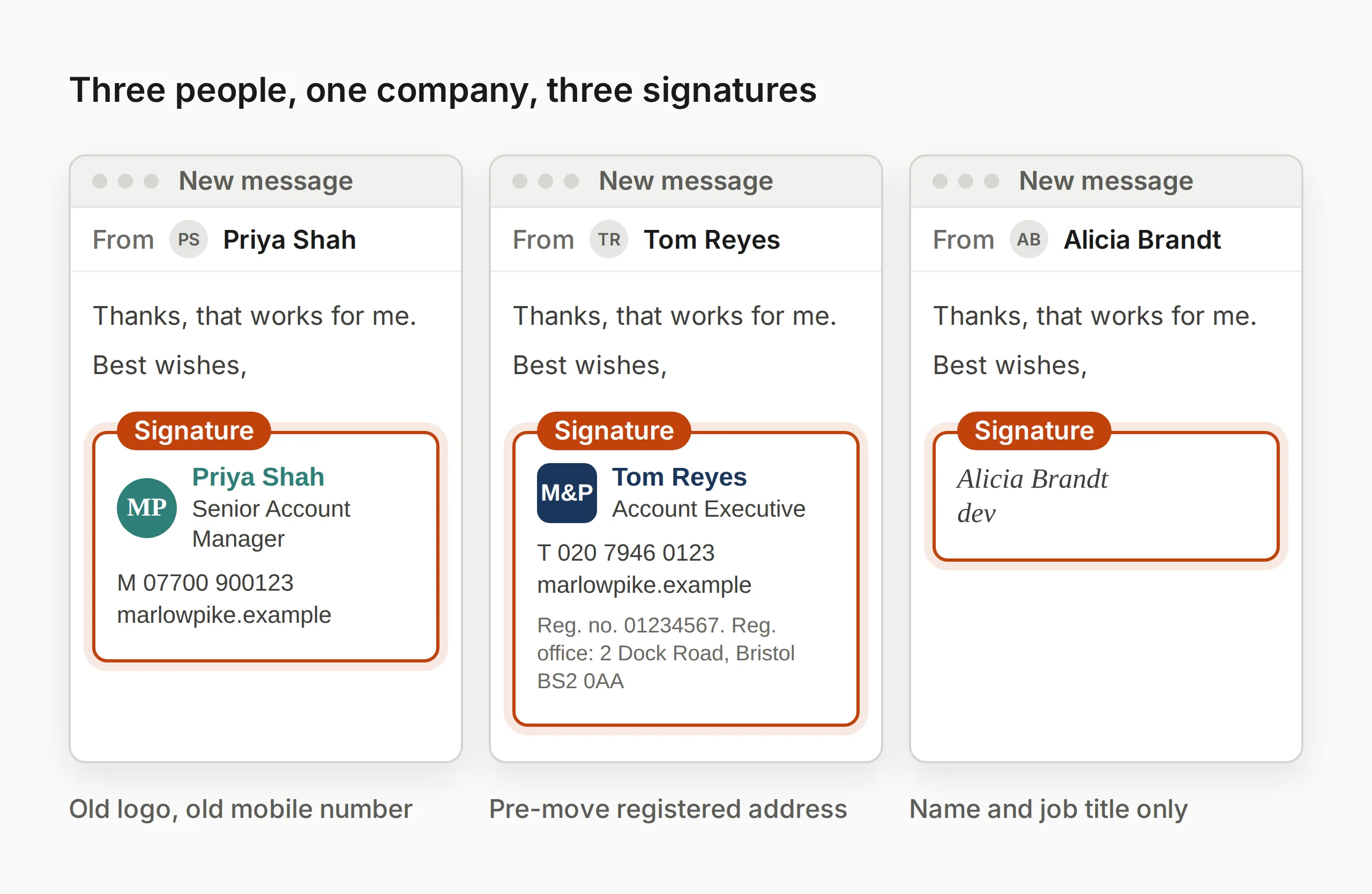
It usually starts the same way. A rebrand happens, or a new starter’s title is wrong on every email they send, or someone in Legal notices half the company’s signatures are missing the registered office address. Someone raises it. It bounces from IT (“that’s a design thing, ask Marketing”) to Marketing (“we don’t have the technical access to roll it out, ask IT”) and sometimes lands with whoever’s newest in Comms or HR, who inherits it by default rather than by design.
The reason this keeps happening isn’t that the problem is hard — it’s that email signatures genuinely sit at the intersection of three functions, each of which owns a real piece of the outcome and none of which owns the whole thing.
What each function actually wants
IT wants the rollout to be secure, compliant, and not generate ongoing support tickets. They’re the ones who’ll get paged if a signature tool breaks mail flow, exposes directory data it shouldn’t, or needs re-deploying every time someone joins or leaves. Their success metric is “it works and I never have to think about it again” — see Centralised Email Signature Management in Microsoft 365 for what that actually involves on the deployment side.
Marketing wants brand consistency — the right logo, the right colours, the right layout, applied the same way across every employee, updated the moment the brand guidelines change. Their success metric is that a client can’t tell which department sent an email just from how inconsistent the signature looks. Sales often sits inside this same accountability line rather than as a fourth stakeholder, wanting the signature treated as an active conversion touchpoint — tracked links, calendar booking, case-study banners — rather than a static footer; see How to Turn Every Sales Email Into a Conversion Touchpoint for that case made in full.
Comms or HR wants the signature to carry accurate, current information — correct job titles after a promotion, correct pronouns and preferred names, a working onboarding mechanism so new starters look right from day one — and increasingly sees it as a tool for onboarding and recruiting, not just a footer. See Email Signatures for HR: New Joiners, Recruiters and Banners for that case in full.
None of these wants are wrong, and none of them cover the whole problem. That’s the actual root cause of the ownership confusion — not indecision, but a genuine three-way split in what “doing this well” means.
The two failure modes
Once you see it as a three-way split, the two common failure patterns become predictable.
No one owns it. Nobody makes the call, so individual employees end up managing their own signatures by default — which produces exactly the drift covered in Why Your Team’s Emails All Look Different: different logos, different fonts, some people with a phone number and some without, and no one accountable for fixing it because it was never anyone’s job to begin with.
One function owns it in isolation. This looks better on the surface — someone’s clearly in charge — but it just relocates the gap rather than closing it. Marketing owns it and the Companies Act 2006 registration details lapse at the next office move because no one flagged the compliance requirement. IT owns it and the design never gets updated after a rebrand, because updating a signature template isn’t on anyone’s roadmap. Comms owns it and it becomes a well-maintained internal channel that IT never signed off on from a data-handling perspective.
Both failure modes have the same fix: name who’s accountable for which specific piece, not who owns “email signatures” as a single undifferentiated thing.
A lightweight RACI for signature ownership
You don’t need a formal governance process for this — a one-page RACI split, agreed once and revisited annually, covers it for most organisations of this size.
| Decision area | Accountable | Responsible | Consulted | Informed |
|---|---|---|---|---|
| Brand design (logo, colours, layout) | Marketing | Marketing (or design agency) | — | IT, Comms/HR |
| Technical deployment and offboarding | IT | IT | Marketing (on rollout timing) | Comms/HR |
| Legal and compliance wording | IT or Marketing (whoever’s accountable above) | — | Legal/Compliance, on Companies Act and any sector-specific rules (FCA, SRA) | Everyone |
| Role/title/onboarding accuracy | Comms/HR | Comms/HR (source of truth) | — | IT (for directory sync) |
The pattern worth noticing: accountability splits by decision, not by function. IT doesn’t need to be accountable for brand decisions to be responsible for deploying them, and Marketing doesn’t need technical access to be accountable for what the signature looks like. The friction in most organisations comes from trying to assign one owner to the whole thing instead of one owner per decision.
The technical reality check: who can actually make the change
Naming an owner is only half the job. That person also needs the technical permission to make changes, so check this rather than assuming it lines up.
Say your signature tool pulls job title, department or pronouns from Microsoft Entra ID. Entra splits the work in two. One role, Attribute Definition Administrator, creates the fields. Another, Attribute Assignment Administrator, fills in the values. By default, even a Global Administrator does not automatically get either right.
Borrow that idea. Whoever you make accountable for job titles needs the permission to fix them, or a clear way to ask someone who has it. Without that, your RACI chart looks right but nobody can act on it.
This is also where the “which persona is this software category built for” question resolves in an interesting way: the market genuinely serves both audiences at once rather than picking one — email signature management platforms are built to serve IT admins managing deployment and directory sync, and marketing teams running the signature as a brand and campaign channel, simultaneously. That’s a reflection of the same three-way split this article describes, not a coincidence.
A governance template for smaller organisations
If a formal RACI feels like overkill — reasonable, at 20 or 50 people — the minimum viable version is naming three people, not three processes:
- A brand owner (usually Marketing) who has final say on design and is the single point of contact when it needs updating.
- A technical owner (usually IT) who controls deployment, onboarding, and offboarding, and who the brand owner goes to when something needs to change.
- A compliance checkpoint — doesn’t need to be a dedicated role, just someone (often whoever already handles the Companies Act and FCA/SRA wording elsewhere) who signs off once a year that the legally required details are still correct.
That’s enough to close both failure modes without adding a governance layer nobody has time for.
Frequently asked questions
Does HR need to be involved in signature ownership?
Only if signatures carry role, title, or personalisation data that HR is the source of truth for — which is increasingly common as more organisations use the signature as an onboarding and internal-comms channel. Where that’s the case, HR should be accountable for data accuracy even if IT and Marketing own deployment and design.
Who is legally responsible if a signature is missing required company details?
Legally, the obligation under the Companies Act 2006 sits with the company, not with whichever internal function happens to manage the signature tool — but in practice, someone needs to be accountable for checking compliance wording is current, which is why it belongs explicitly in a RACI rather than being assumed to be “someone else’s job.”